logo

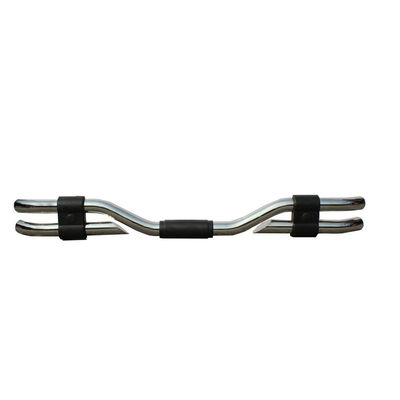
 Key Selection Criteria: 4 Core Indicators for Truck Deer Guards in Different Scenarios

November 25, 2025

Laatste bedrijfsnieuws over  Key Selection Criteria: 4 Core Indicators for Truck Deer Guards in Different Scenarios
Key Selection Criteria: 4 Core Indicators for Truck Deer Guards in Different Scenarios
1. Vehicle Compatibility (Avoiding "Wrong Fit, No Effect")
  • Selection: Must be based on the truck's wheelbase and front-end structure.

    • Light/Medium-Duty Trucks: Choose a "Compact Guard" (width matches the vehicle's track width to avoid excessive wind resistance).

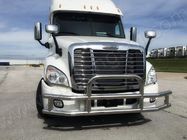
    • Heavy-Duty/Semi-Tractor Trucks: Choose a "Reinforced Guard" (coverage must extend past the outer edge of the front wheels to prevent animals from entering the wheel gap).

  • Safety Clearance: Ensure adequate clearance is maintained for the bumper, fog lights, and license plate area to avoid obstructing safety devices.

2. Material and Strength (Determining Impact Resistance)

① Material Comparison:

  • High-Strength Steel Guard: Strong impact resistance, suitable for heavy-duty trucks frequently traveling in wooded areas; can withstand impacts from animals weighing $mathbf{500text{kg}}$ or more.

  • Aluminum Alloy Guard: Lightweight, suitable for light-duty/intercity hauling; $mathbf{30%}$ lighter than steel, resulting in lower fuel consumption, but with weaker resistance to repeated impacts.

② Critical Strength Standards:

  • Must comply with vehicle protection device national standards (e.g., China's GB/T 26512-2011, "Requirements for Front Underrun Protection of Commercial Vehicles") or international standards (e.g., North America's DOT FMVSS 223 safety specifications).

  • Guard cross-member thickness must be $mathbf{ge 3text{mm}}$, and weld tensile strength must be $mathbf{ge 450text{MPa}}$.

3. Structural Design (Preventing "Secondary Damage After Collision")

① Underride Prevention:

  • The guard's bottom must be fitted with an "anti-underride plate" (ground clearance $mathbf{le 30text{cm}}$) to prevent small animals from going under the guard.

② Crumple/Energy Absorption:

  • Some high-end models feature a "progressive crumple structure" (e.g., elastic connectors, creased cross-members). During a collision, structural deformation absorbs impact energy, reducing the reaction force transferred to the cab (prevents excessive rigidity of the guard from causing cab deformation).

③ Ease of Repair:

  • Prioritize modular designs (e.g., removable cross-members, bolt-connected parts). This avoids having to replace the entire unit after a collision, allowing for repair of only the damaged module, thereby reducing long-term maintenance costs.

4. Compliance (Avoiding Fines)
  • Must comply with the regulations of the operating region:

    • North America (Some States): May require the guard height to be no less than $mathbf{40text{cm}}$ and no more than $mathbf{70text{cm}}$ (to avoid obstructing pedestrian sightlines).

    • China: The guard must not exceed the overall width of the vehicle and must display reflective markings (to enhance night visibility).

  • Guards lacking compliance certification may face penalties during road inspections.

Neem contact op met ons
Contactpersoon : Miss. Bella Huang
Tel. : +8618027731935
Resterend aantal tekens(20/3000)